
Over the past year, Abu Dhabi has been one of the world’s fastest-growing prime property markets. Apartment values rose 24.1%, growth on a scale most markets have not seen in years – if ever. Transactions across the emirate reached AED 117 billion (USD 31.9 billion) in the first half, up 112% on H1 2025, while money from non-resident buyers climbed 309% to AED 13.8 billion (USD 3.8 billion), spread across 116 nationalities. Capital is arriving from more of the world, and faster.

Together with Dubai, it places the UAE among the property markets that global capital now treats as a first stop. The surge is backed by sovereign wealth and government-owned developers, the kind of foundation that gives international buyers the confidence to commit. Most of the growth runs through a handful of islands and a small group of developers, and that is where both the opportunity and the risk sit.
Abu Dhabi & Dubai Property Compared in 2026
| Measure | Dubai | Abu Dhabi |
|---|---|---|
|
Apartment price growth |
+9.6% YoY (to Q3 2025) |
+24.1% YoY (to Q2 2026) |
|
Average apartment price |
AED 2,010 per sq ft (USD 547) |
AED 1,442 per sq ft ready (USD 393); AED 2,104 off-plan (USD 573) |
|
Gross rental yield |
6.68% city-wide, 7.15% apartments |
6% to 8% in income districts |
|
Supply pipeline to 2030 |
350,000 homes, 71% already pre-sold |
37,700 (ValuStrat) to 71,000 (ADREC) by 2030, peaking 2028 |
|
Liquidity and track record |
Deep resale market, dozens of developers, longer record |
Thinner resale, a small group of developers, newer market |
|
Best suited to |
Consistency, liquidity, established demand |
Capital growth held over time |
The two markets have diverged this cycle. Dubai apartment prices rose 9.6% in the year to Q3 2025 and now average around AED 2,010 per sq ft (USD 547 per sq ft) on Savills’ Q1 2026 figures. Abu Dhabi apartments grew 24.1% over a comparable window and change hands at AED 1,442 per sq ft (USD 393 per sq ft) for ready stock, AED 2,104 per sq ft (USD 573 per sq ft) off-plan. An investor buying ready apartment stock in Abu Dhabi pays less per square foot and has seen faster appreciation.
Yields sit close together. Dubai’s city-wide gross rental yield was 6.68% in April 2026, with apartments at 7.15%. Abu Dhabi’s income districts run in a similar band: Al Reem Island apartments yield 6% to 8% gross, Masdar City reaches into the 7s, Yas Island sits around 7% on long lets. An investor gives up no meaningful income by holding either.
Supply is where the two differ most. Dubai could complete around 350,000 homes between 2026 and 2030, a volume only a market its size could take on, and roughly 71% of the off-plan pipeline due through 2029 is already sold. That depth is a strength Abu Dhabi cannot yet match. It also means the highest-volume communities, Jumeirah Village Circle and Dubai South among them, are seeing some price softening where handovers cluster, which Knight Frank flags as a mounting oversupply risk to watch. Abu Dhabi’s pipeline reads differently depending on the source. ValuStrat’s Q2 2026 review put around 37,700 units through 2030, while ADREC’s H1 2026 report sets the emirate-wide pipeline nearer 71,000 units by 2030, with deliveries peaking around 21,800 in 2028. Off-plan already dominates sales there, 89% of residential value and 82% of deals in H1 2026, though how much of the future pipeline is committed varies by project and by developer.
Dubai’s advantages are the ones a mature market earns. It is more liquid, with a deeper resale market and dozens of active developers, so exit is faster and pricing is easier to read. It has the longer track record and the stronger international brand, which feeds short-let demand. Abu Dhabi replaces none of that. It adds a newer, smaller market with faster recent appreciation and less completed stock to absorb, which suits capital growth held over time. For most investors, the choice is how much of a UAE position to place in each emirate.
Why Abu Dhabi Property Makes Sense Now
The hype has a basis. Abu Dhabi holds the bulk of the UAE’s oil reserves and its sovereign wealth, and that capital is being pointed at diversification, culture and residential development on a scale that shows up in transaction data. Its sovereign wealth funds, ADIA, Mubadala and ADQ, rank among the largest pools of investment capital anywhere, and they are what pays for the islands, the cultural district and the infrastructure regardless of the oil price. FDI climbing fourfold in a single half-year is not a marketing figure. It came from 116 nationalities against 82 a year earlier, led by the United Kingdom, China, Russia and the United States. The buyer base is broadening.
There is weight underneath it too. Emiratis took just over a quarter of the year’s growth in sales value, and the emirate runs 233,000 active residential leases with new-lease rents up 17%, so a large share of the market is lived-in rather than traded.
The next five years will build on these foundations. Etihad Rail’s national passenger service began in June 2026, and its Dubai station is scheduled to open on 30 September. A separate high-speed Abu Dhabi to Dubai service is planned to cut that journey to around 30 minutes, while emerging links such as air taxis could widen the pool of people for whom living or investing here is practical. The financial centre is pulling demand the same way. ADGM has filled its offices to the point where prime and Grade A space is effectively full, and in late 2025 Mubadala and Aldar announced a AED 60 billion (USD 16.3 billion) expansion of the Al Maryah Island district that will roughly double that Grade A space. More finance jobs feed the residential districts around them.
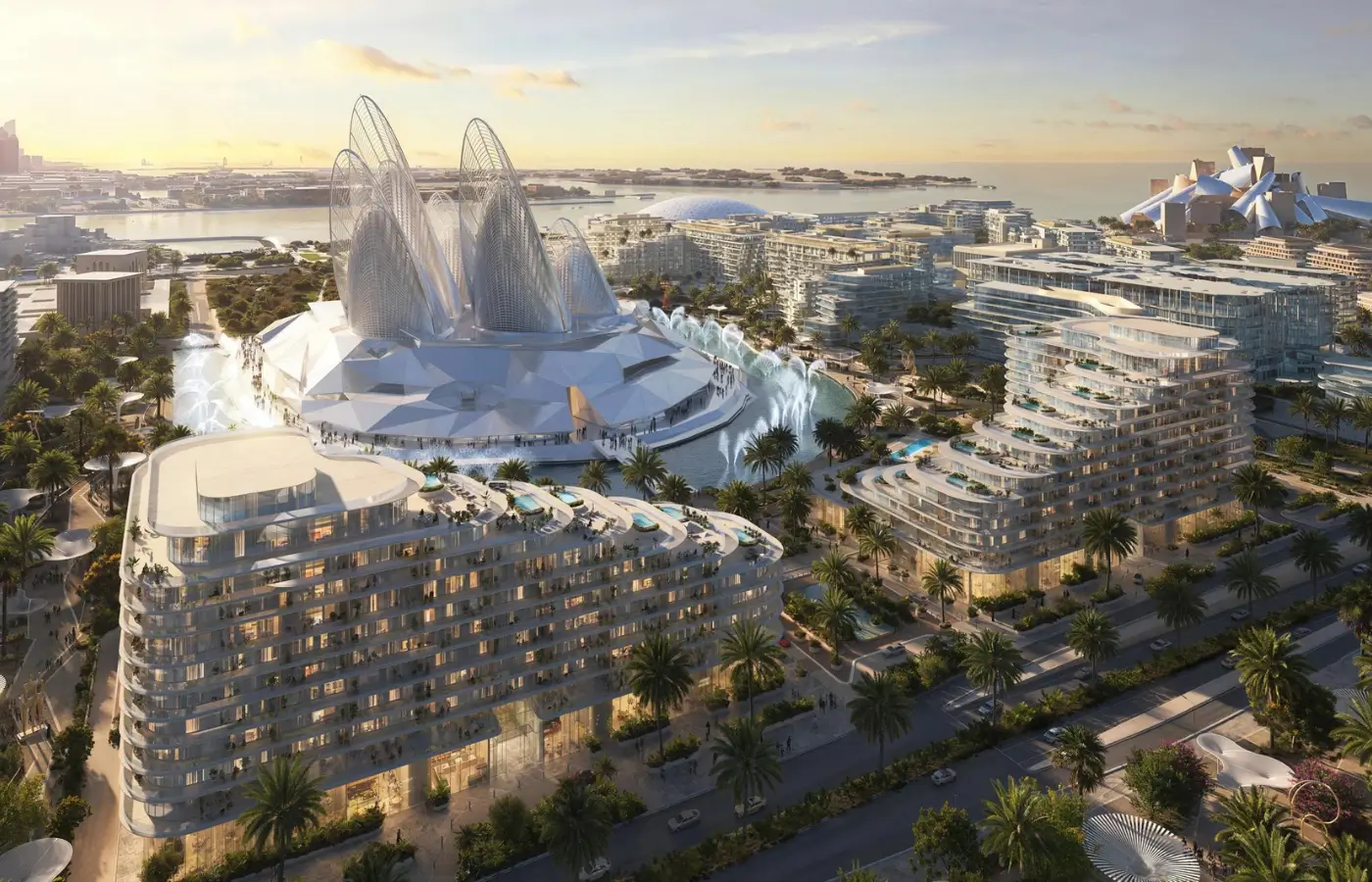
The policy backdrop has moved as fast as the prices. The emirate approved eight new investment zones in H1 2026, taking the freehold-eligible total to 50, which opens more of the map to foreign ownership. The Madhmoun system has issued more than 41,200 advertising permits since launch, cleaning up listing data and pulling the market toward the transparency Dubai reached years ago. And the cultural district on Saadiyat is moving from render to reality, with the Guggenheim and the Zayed National Museum joining the Louvre, which makes Saadiyat a place to live, on top of a place to own.
Geography works in its favour too. Much of the emirate is built across natural islands, so a large share of its homes sit on or near the water. Waterfront property commands a premium that endures through cycles, and in Abu Dhabi a far wider slice of the market carries that advantage than in most cities.
Residency reinforces the case. A qualifying property purchase from AED 2 million (USD 545,000) puts an investor on Abu Dhabi’s ten-year Golden Visa for real estate investors, one of the more direct property-linked residency routes in the region.
The Best Areas to Invest in Abu Dhabi in 2026
Abu Dhabi’s islands run from income-led to growth-led, and most offer a measure of both, so an investor can lean towards yield or towards capital growth and still capture some of the other.
Al Reem Island
Al Reem carries the emirate's most dependable tenant demand, with gross apartment yields of 6% to 8%. High-rise and walkable, sitting next to the mainland business district, it is Abu Dhabi's clearest income buy. Prices sit around AED 1,853 per sq ft (USD 505 per sq ft). Capital growth has kept pace too, with apartment values up 22% in the year to June 2026. Reem villas are the exception to the whole market, down 22% over the same period, so buy the apartments for income and leave the villas. Al Reem now sits inside ADGM's jurisdiction, so property there is held under English common law, which international and UK buyers know well and which gives them familiar ground on title and dispute resolution.
Yas Island
A roughly 7% long-lease yield puts Yas in the middle of the range, and its tourism engine, Ferrari World, Warner Bros. World and Yas Bay, adds short-let demand on top. Apartment prices rose around 18% in the year to mid-2026. Yas also carries the largest single pipeline in the emirate at about 7,700 units, so buyers should weight developer and micro-location carefully rather than assuming the tide lifts everything. The tourism pull is about to grow. A Disney resort has been announced for Yas, and Miral, the island's master-developer, is putting AED 12 billion (USD 3.3 billion) into new hotels and attractions over five years, both of which deepen the short-let demand that supports Yas yields.
Saadiyat Island
Saadiyat trades yield for prestige. Apartment yields sit near 3.5% on Bayut's H1 2026 data, well below the income districts, while the cultural anchors and low-density planning draw high-net-worth buyers. Apartment prices reached AED 43,100 per sqm (USD 11,736 per sqm) after 21% annual growth, among the highest in the emirate.
Al Jubail Island
Al Jubail's low-density waterfront villas posted around 40% annual price growth in H1 2026, the strongest of any segment. Supply is tight and the buyer is an owner-occupier or long-hold investor, which is what has driven the appreciation. Liquidity is thinner than the apartment islands, so plan the exit before entering.
Masdar City
Masdar City offers some of the emirate's highest apartment yields, around 7.6% on Bayut's H1 2026 data, at lower entry prices than the beachfront islands. The sustainability-led district near Zayed International Airport is still completing through 2027 and 2028, and it suits an investor optimising income per dirham committed.
Hudayriyat Island
Hudayriyat is Modon's masterplan island off the western edge of the city, pairing sports and leisure infrastructure with new villa and townhouse communities. Its Golf Estates release cleared AED 13 billion within days in July 2026. Freehold and aimed squarely at foreign buyers, it has become one of the first islands overseas investors ask about, though it is early in its build-out and mostly a house rather than an apartment market.
Abu Dhabi Property Developers to Know in 2026
The developer roster is short, and that shapes the market. Aldar Properties dominates. It stands behind The Canopies at Yas Point (592 apartments launched into AED 1.5 billion of initial sales), the Fahid Island masterplan (more than AED 3.5 billion in sales during its launch week, on a plan worth over AED 40 billion), and The Row on Saadiyat, part of an ultra-prime segment where average prices reached around AED 3,893 per sq ft (USD 1,060 per sq ft) in H1 2026. Its largest play is Marsa Al Saadiyat, a AED 100 billion (USD 27.2 billion) waterfront and marina masterplan launched in 2026 across 6.4 million sqm, the final major development on Saadiyat Island. Buying new-build Abu Dhabi in 2026 usually means buying Aldar, which is a strength for delivery record and a concentration risk for a portfolio.
Modon is the government-linked challenger and the more interesting recent story. Its Hudayriyat Golf Estates release cleared AED 13 billion within days in July 2026, and Modon partnered with ADIB to launch off-plan financing of up to 75% loan-to-value, the first structured product of its kind in the emirate and a lever for buyers who do not want to fund construction from cash. Eagle Hills is developing Ramhan Island, the archipelago and floating-villa project at the luxury end.
Abu Dhabi Off-Plan Launches to Watch in 2026
The masterplan to track is Marsa Al Saadiyat. Aldar’s AED 100 billion scheme on the last major plot of Saadiyat sits next to the cultural district, will hold Abu Dhabi’s largest marina, and is planned around its own underground Etihad Rail station, tying the launch straight into the connectivity story above. On Saadiyat, Baccarat Residences, designed by Sou Fujimoto, and The Row hold the ultra-prime end for buyers underwriting scarcity and brand. On Yas, The Canopies offers a mid-rise waterfront product in a market where Bayut’s H1 2026 data puts projected Yas apartment ROI near 5.9%. Reem Hills continues to release on Al Reem for the income buyer.
Two things separate a good off-plan entry from a poor one here: the payment plan and the handover date. Modon’s ADIB financing changes the arithmetic for buyers who would rather borrow than tie up cash through construction, and it is worth pricing against a developer’s own post-handover plan before committing.
Abu Dhabi Property Market Outlook & Historic Performance
The ValuStrat Price Index reached 151.1 in Q2 2026, 51% above its base, after a run of quarterly gains. Apartments carried it, up 24.1% year-on-year to an index of 147.5, while villas rose 12.0% to 154.8. Al Reef led apartment appreciation at 41.6%, ahead of Al Muneera at 24.7% and Al Reem at 22.0%.
The most recent quarter cooled. Q2’s 2.1% quarter-on-quarter gain was the softest in two years, which reads as the market settling into a steadier pace. ValuStrat also flags that its announced pipeline may be revised down. ADREC’s H1 2026 report puts the emirate-wide figure nearer 71,000 units by 2030, so the supply outlook depends heavily on which dataset you take.
The risks are worth naming plainly. Liquidity is thinner than Dubai, so resale takes longer and the buyer pool for any given unit is smaller. Developer concentration means Aldar’s delivery and pricing decisions move the market more than any single firm does in Dubai. And divergence within the emirate is real, as Reem’s 22% villa decline against its 22% apartment rise shows. A buyer picks a segment, not a postcode.
For 2026, the strategy that fits the data is an apartment on an income island for yield with growth attached, or a Saadiyat asset held for appreciation, financed through Modon’s ADIB product where the numbers favour leverage over cash. Abu Dhabi has earned a place in a UAE portfolio that it did not hold a few years ago. It belongs next to Dubai, and it rewards the buyer who picks carefully.
Sources:
Abu Dhabi Real Estate Centre (ADREC) – H1 2026 Transactions & FDI, Abu Dhabi Real Estate Centre (ADREC) – H1 2026 Real Estate Market Report, Knight Frank – Abu Dhabi Residential and Office Market Review, Summer 2026, ValuStrat – Abu Dhabi Property Market Q2 2026, Bayut – Abu Dhabi Sales Market Report H1 2026, Abu Dhabi Residents Office – Golden Visa for Real Estate Investors, Aldar – The Canopies at Yas Point, Aldar – Fahid Island Sales Performance, Modon – Hudayriyat Golf Estates Sales Performance, Modon & ADIB – Off-Plan Home Financing, ADGM – Al Reem Island Real Estate Jurisdiction, Miral – AED 12 Billion Yas Island Investment, The Walt Disney Company & Miral – Disney Resort on Yas Island, Etihad Rail – UAE Passenger Rail Network, Etihad Rail – Abu Dhabi–Dubai High-Speed Rail, Abu Dhabi Media Office – Marsa Al Saadiyat, Abu Dhabi Media Office – Al Maryah Island Financial District Expansion.